
LinkedIn Best Practices That Matter (and the Updates You Can’t Ignore)
Dec 10
By Blair Kelly, Niki Clark Marketing
Approximate read time: 7-8 minutes
Key Takeaways
1. Teach first, sell later
Short text posts and quick tips win. Share one clear idea, bust a myth, or simplify a concept. Action: write three one-line lessons and schedule them this week.
2. Consistency beats clever
Post two to three times per week, then stick around to reply. Aim for mid-morning Tuesday to Thursday and test your own best times. Action: pick two posting windows and add them to your calendar.
3. Optimize your profile, then watch the data
Treat your profile like a landing page and your analytics like a compass. Clear headline, strong banner, and monthly checks on impressions, engagement, CTR, and audience fit. Action: add three client outcomes to your About section today.
If you’ve spent any time on LinkedIn, you probably know by now that it changes… a lot. What worked six months ago (or even less!) might already feel stale, and honestly, most financial advisors don’t have time to chase every algorithm update while running a business.
But with over 1.2 billion members and 1.77 billion monthly visits, LinkedIn isn’t optional anymore, especially if you want to grow your brand, attract high-quality clients, and stay relevant in an increasingly digital world.
So, what is working right now on LinkedIn? We’re breaking down the latest best practices and the ones worth your time (until they change again, of course… we’ll keep you posted 😉).
The Current State of LinkedIn
Before we fast-forward, here’s a quick status check on LinkedIn now.
LinkedIn has also made one major shift that advisors can’t afford to ignore. The platform has stated that engagement now outweighs content itself. That doesn’t mean you shouldn’t create strong posts. But it does mean LinkedIn prioritizes the conversations happening around your content more than the content alone. Quality comments, back-and-forth discussion, and early interaction signal relevance and push your posts into more feeds. If you’re treating LinkedIn like a publishing platform instead of a networking platform, you’re leaving reach and visibility on the table.
LinkedIn is a professional storytelling and networking powerhouse.
Here’s who’s spending time there right now:
- 47% of users are between the ages of 25–34
- 4 out of 5 members influence business decisions
- Over half have household incomes above $100k
Your next ideal client, referral partner, or COI is probably already online, researching, reading, and deciding who to trust. So, if you’re not showing up, someone else is.
So, what does this mean for advisors?
- Treat your profile like a landing page. Add a benefit-focused headline and a banner that shows who you help. Make this information easy to spot and draw them in quickly.
- Add three client outcomes to your “About” section. Keep them short and sweet (but be specific).
And before we look ahead to 2026, let’s cover what’s actually getting reach and real conversations on LinkedIn right now.
What’s Working Right Now?
TL;DR: Less “look at me,” more “learn from me.”
Short, sharp text posts that educate readers
These are quick-hit, 1 to 2-sentence posts that provide immediate value. They grab attention and deliver a key insight or perspective. These are perfect for fast feeds like LinkedIn or X when people are skimming. It’s best when you bust a myth, clear up a confusing idea, or simplify something we all overthink… and overthinking never got us anywhere.
Example: Most investors think volatility is the enemy. The real threat is emotional decision-making.
Quick videos (under 15 seconds) with practical tips
Think short, “how-to” clips. One focused tip, delivered quickly. (Short attention spans are no longer just for toddlers.) These are ideal for Instagram Reels, TikTok, or YouTube Shorts. Pick a single idea and stick to it.
Here are some simple example topics:
- A simple rule of thumb for emergency funds
- One mistake professionals make when planning for retirement
- The fastest way to explain compound interest to a client
Keep your content educational. Lose the sales pitch
Show how something works. Answer a real question. Invite conversation instead of pitching.
What formats work?
- A jargon-free explanation of tax brackets that shows what changes from bracket to bracket
- A short article that makes the sequence of returns risk easy to grasp
- Myth versus fact post that clears up common retirement assumptions
Here are a few things to try:
- Draft three one-line teaching posts and schedule them for next week
- Record one 12-second tip on your phone. Add subtitles for “sound-free” listening and a clear title
- End every post with a question that your clients would actually ask
When to Post to Stay Relevant (and Why Timing Still Matters)
You can write the best post ever and bury it by posting at the wrong time. As a baseline, weekdays, mid‑morning in your audience’s time zone tend to perform well. But your audience isn’t generic.
Try this simple test plan:
- Pick two time windows (e.g., Tue 10:30 a.m., Thu 12:15 p.m.) and run them for four weeks.
- Keep content types similar so you can compare apples to apples.
- Note your top two performing times and use them for next month. Re‑test quarterly.
And remember, the changes won’t happen overnight. Pay attention to what’s working and what needs tweaking.
LinkedIn Analytics, No Marketing Degree Required
LinkedIn gives you a ton of data, but not all of it is useful. The key is knowing which numbers help you boost your visibility, build credibility, and attract the right audience. Here’s what to focus on:
1. Impressions = Visibility
This tells you how many people saw your post. How far has your content traveled across LinkedIn? If your impressions are high, it means your opening line or format likely caught attention and earned reach. (Borat voice: high fiiiive!)
Why it matters: If your impressions are consistently low, your content may not be showing up in feeds or may not be stopping the scroll. It’s a signal to try new hooks, visuals, or post times.
2. Engagement Rate = Resonance
Engagement includes likes, comments, and shares, measured against total impressions. This shows whether your content is connecting emotionally or intellectually with your audience.
Why it matters: High engagement means your message is hitting the mark. It’s starting conversations and making people think. This kind of content builds trust and helps your profile show up in the algorithm.
3. Follower Demographics = Audience Quality
This shows who is following you by job title, industry, and location.
Why it matters: Your audience should reflect your ideal clients or referral partners. If you’re seeing growth but from the wrong segments, your content may be drawing attention without proper alignment.
4. Click-Through Rate (CTR) = Real Interest
CTR tells you how many people clicked a link in your post, whether it’s to read more, visit your website, or watch a video.
Why it matters: A high CTR shows true curiosity. These are the people who are willing to go deeper. It’s a strong sign that your content is not just visible, but also valuable.
👉 Pro tip: Don’t obsess daily. Check analytics monthly, and look for trends over time.
The 2026 Shifts (and How to Stay Ahead of It)
Because just when you figure it out, LinkedIn could change again.
LinkedIn is always evolving. What worked a few months ago might not perform the same today. The platform doesn’t announce every shift, but there are clear trends in how the algorithm is prioritizing content right now.
LinkedIn’s 2025→2026 tweaks keep pushing the feed toward meaningful dialogue, clear expertise, and readable, topic-focused content instead of vanity posts.
Some things to remember:
1. Conversation beats broadcasting
Posting and walking away doesn’t work. The algorithm favors content that sparks real back-and-forth conversation (quality comments, saves, longer read time). These get wider distribution. Early, meaningful replies from you extend a post’s life.
What to do: Ask real questions. Respond to comments. Treat your posts like the start of a conversation, not a monologue. Add clear follow-ups to keep the thread useful.
2. Authenticity and expertise beat perfection
Corporate speak is easy to ignore. Just keep it real and sound like a human, and you’ll really connect. Advisors who show personality and speak from experience tend to build more trust and get better engagement.
What to do: Write like you talk. Be clear, be real, and don’t over-edit the life out of your message. And stick to your niche.
3. Keep storytelling educational
Posts that teach with stories do well. Whether it’s a client scenario, a personal mistake, or a behind-the-scenes lesson, content that shares what you’ve learned is both helpful and relatable.
What to do: Share real moments. Show how you handled a challenge or uncovered a financial insight. Focus on the takeaway.
4. Make your topics easy for algorithms
As LinkedIn leans on AI summaries and topic cues, clear, keyworded first lines help both people and the feed understand who your post is for.
What to do: Lead with the topic + audience (“Tax brackets for new retirees: 3 quick myths”), avoid jargon, and keep one idea per post.
LinkedIn continues to push toward faster, smarter, and more personalized content.
Not sure what to share without sounding salesy? Think of your feed like grabbing a quick coffee with a prospect. Show up with something useful, keep it “real”, and leave your readers with a little something that they didn’t know before.
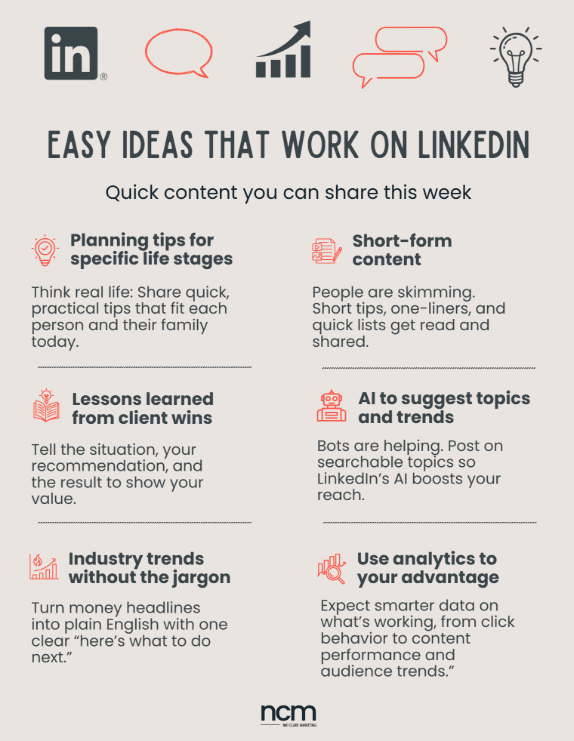
Easy Ideas That Work on LinkedIn
Planning tips for specific life stages
Retirement, new parents, career changes. Meet people where they are. Show that your guidance fits each person and their family situation, not “one size fits all.” Keep it bite-sized and practical so someone can use it today.
Lessons learned from client wins (anonymized, of course)
These stories work because they feel real. Tell the situation, the move you recommended, and the result. Real stories feel real, and they quietly demonstrate your process and value.
Industry trends translated into plain English
Skip jargon. Explain what a headline, rule change, or market move actually means for a non-financial person (ahem…me) and what they might do next.
💡Bonus tip: Complete your profile. Advisors with fully optimized profiles (including banner image, headline, and keywords like “fiduciary” or “retirement income planning”) get 30% more views per week.
Short-form content
People are skimming. Content that gets to the point quickly is more likely to be read, remembered, and shared. Think short tips, one-liners with impact, or quick lists.
AI isn’t going anywhere
Don’t worry, the bots aren’t taking over, but they’re helping us to market better. LinkedIn is starting to use AI to suggest topics, summarize content, and highlight trends. Content that aligns with clear, searchable topics may get more reach.
Smarter analytics
Expect more data on what’s actually working. LinkedIn is moving beyond surface-level metrics and offering insights into click behavior, content performance over time, and audience trends.
Use LinkedIn’s Boolean Search to Find Ideal Clients and COIs Faster
Most advisors don’t realize LinkedIn has a built-in Boolean search engine that works like a secret filter for finding the exact people you want to connect with. Boolean search lets you combine keywords using terms like AND, OR, and NOT to narrow your results and surface the right professionals instead of scrolling endlessly.
This is one of the most underrated ways to grow your network strategically instead of randomly.
Examples:
- “HR Director” AND “Atlanta”
- “Business Owner” AND “Construction” NOT “Consultant”
- “CPA” OR “Enrolled Agent” AND “Small Business”
- “Pre-retiree” OR “VP” OR “Director” AND “Healthcare”
Boolean search is fast, precise, and perfect for advisors who want to intentionally build a network of people who match their niche instead of accepting random requests.
Pro tip: Build three saved searches aligned with your core audiences. Check them weekly and send connection requests with a short, value-focused note.
Quick Wins for Financial Advisors on LinkedIn
Headline audit: Make it client-focused
Your LinkedIn headline is prime real estate, and most advisors waste it on a job title. A high-performing headline speaks directly to your ideal client, highlights the specific outcome you help them achieve, and includes a differentiator that positions you as a strategic growth partner rather than another advisor in the feed.
Use this simple, high-impact formula:
[Strategic Identity] | [Client Outcome] | [Differentiator or How You Deliver It]
This shift helps you stand out in search results, attract higher-quality prospects, and instantly communicate the transformation you create.
Example:
Instead of: “Financial Advisor at XYZ Firm”
Try: “Retirement Income Strategist | Helping Pre-Retirees Create Confident, Low-Stress Retirement Plans.”
It is clear, client-focused, and outcome-driven, and it tells your prospects exactly why they should pay attention.
Post two to three times per week: Consistency is key
You don’t need to post every day. What matters is showing up regularly. Posting two to three times per week is enough to stay visible and build momentum without burning out. Create a steady rhythm so your audience begins to expect and engage with your content.
If your schedule doesn’t allow for several posts each week, don’t force volume. LinkedIn’s algorithm rewards consistency more than frequency. Even showing up once a week at the same time can build momentum because the platform learns when to expect you and when your audience engages. If Tuesdays at 10:30 a.m. are the only window you can realistically commit to, stick with that. Predictability helps your content perform better than posting sporadically whenever you find a spare minute.
Tip: Batch your content ideas once a month so you’re not scrambling to come up with something new every week.
Engage with others: Comments keep your profile visible
LinkedIn rewards interaction. When you leave meaningful comments on other people’s posts, especially those in your network or target audience, it increases your visibility and positions you as an active voice in the conversation. This is one of the most underrated ways to grow your presence.
Strategy: You only need 10 minutes a day. Spend time commenting on five to ten posts. Don’t just say “great post.” Add real value or ask a question that sparks conversation.
Share milestones and lessons: Real stories build real trust
People connect with people, especially in our increasingly digital world. Sharing client wins, lessons learned, or even mistakes made (without revealing private information) helps humanize your brand. These stories show your values, your process, and your impact, which builds credibility far better than generic content ever could.
Ideas to try:
- A recent challenge a client overcame with your help
- A lesson you’ve learned from years in the industry
- A personal milestone that ties back to your professional journey
Review analytics monthly: Let data guide your content
Instead of guessing what works, use LinkedIn’s built-in analytics to track which posts are performing well. Look at impressions, engagement rate, and click-throughs to identify patterns. Over time, this helps you refine your voice, choose better topics, and focus on content that drives real interest.
Reminder: Don’t get caught up in daily stats. Look for trends over time and use that data to double down on what resonates.
Final Thoughts
LinkedIn in 2026 runs on consistency and real connections. Show up regularly, teach something useful, and sound like an actual human. Forget flawless. Focus on trust and relevance. The advisors that are winning aren’t chasing flashy graphics or one-off virality. They’re the ones sharing informed takes, starting real conversations, and staying visible through steady, intentional engagement.
You don’t need every new feature or trend to succeed. Pick a cadence you can stick to, keep delivering value, and let the algorithm do what it does. Your audience cares more about reliability than reach, and they’ll remember the advisor who shows up with something genuinely helpful. Keep the dialogue going, and LinkedIn will work for you, not the other way around.
Sources:
1 SproutSocial
2 Buffer