
Best Practices for Answer Engine Optimization (AEO) Marketing Teams Can’t Ignore
Jan 14
By Blair Kelly, Niki Clark Marketing
Approximate read time: 12-14 minutes
Key Takeaways
1. Make your answer easy to grab.
Put the main answer first, in plain language. Then support it with steps, facts, and sources so Google and AI can quote you easily.
2. Good structure beats tricks.
You don’t need secret hacks or fancy AI tricks. Clear writing, simple page structure, and strong SEO basics still win.
3. Only use schema that fits the page.
If your page is not really an FAQ or a how-to, don’t label it as one. Honest, accurate markup helps search engines trust and use your content.
4. Write for real people, not robots.
Use clear headings, short sections, and words people actually search for. If a human can understand it fast, AI usually can too.
5. Check what’s actually working.
Use Google Search Console to see real results. Don’t guess. Track what gets shown, quoted, and clicked so you know what to improve.
Answer Engine Optimization (AEO) is not a shiny new marketing trend. It’s a reality check.
Search is changing. People are not clicking through pages of results like they used to. Now they expect Google to just give the answer.
That creates a new problem: ranking high is not the same as getting quoted. If Google AI Overviews or tools like ChatGPT cannot pull a clear, trustworthy answer from your site, you may not show up at all where people look first.
This guide gives you a simple playbook to fix that. You’ll learn how to write pages that are easy to scan, easy for AI to understand, and easy to cite. We’ll cover page structure, which schema matters (yes, we’ll explain what schema means), how to avoid “fake” markup, and how to track results with real data, not guesses.
One heads-up: a few parts get technical. But we’ll keep it practical.
Why This Matters
Search used to be a library. Now it’s more like a speed-dating host with a stopwatch. Answer engines scan the room, pick the clearest talkers, and move on. If your page doesn’t speak in clear, snackable bites, you’re left on read. You need transparency, structure, and proof that you’re worth quoting.
What Wins Now?
Lead with the answer. Give readers the TL;DR (Too Long; Didn’t Read) in one short sentence that can be lifted verbatim. Then unpack the why, the how, and the gotchas. Think “headline first, movie later.”
Structure for Clear Answers
One intent per page. In other words, pick a lane. It can be easy to go off in an entirely different direction from where you started – you should see our Slack channels. But try to remember that each page should answer one main question. Not three. Not “and while we’re here…”
- Keep it scannable. Use H2/H3s that match real questions, aka what people actually type into Google/ChatGPT.
- How-to format: Lead with the practical stuff (tools + time + cost), then list the steps in order.
- “What is…?” Your pages will need a 1-sentence definition box right under the intro.
- Comparison tables: They should be titled with the exact search phrase (e.g., “SEO vs AEO”) so both humans and robots alike will instantly get the point.
It’s an easy read, and it makes it easier for search, and AI 🤖, to grab the best answer.
Use the right schema accurately
Add JSON-LD. That’s a small piece of behind-the-scenes code that tells Google and AI tools what your page is about. In simple terms, it helps them read your content correctly.
Use the schema type that matches the page. For example: FAQ Page, How To, Article, Product, Organization, or Author. Make sure it reflects what’s actually on the page. No pretending. Just real, accurate information.
Before you publish, double-check your schema. If it’s wrong or broken, your rich results can disappear without warning.
Write clearly about real things, not just keywords. Name specific products, versions, rules, or standards. Use internal links to connect related pages so both readers and search engines can follow along easily.
- Show real expertise. Put a real person on the byline. Explain how you know what you know. Link to original sources so your answers feel trustworthy, not made up.
- Keep the page clean and easy to use. Make it fast, simple, and clutter-free. Important facts should be written out in text, not hidden inside images. Use visuals only when they help explain something.
- TL;DR: Match your schema to what’s actually on the page and write clearly, so Google and AI can read, trust, and quote your content.
How To Build “Answer-Ready” Pages That Humans and AI Can’t Resist
This is for financial advisors who want their content to actually get quoted by Google, AI Overviews, and all those new “answer engines.” You don’t want them to just sit there looking pretty on your site, but not do the work you need them to do.
Think of this as your how-to for building pages that say:
“Pick me. I’m clear, citable, and ready to shine.”
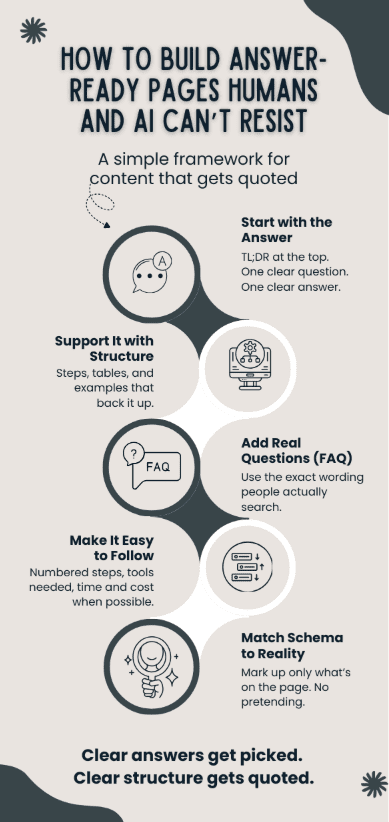
Start With The “Too Long; Didn’t Read” (Your “Quote Me” Block)
Before you write a whole page, write the one paragraph you want AI and search results to lift.
- Make it standalone and specific. Answer one clear question in plain language.
- Include key terms a real person would use when they search.
Then build the rest of the page around that.
- Add sections with steps, tables, and examples that support it.
- Read your copy out loud.
- If it sounds like something a human would type into a search bar? Keep it.
- If it sounds vague, robotic, or like it belongs in a policy manual? It’s time to do some editing.
- If it’s hopeless… start from scratch. The “Too Long; Didn’t Read” is too important to ditch, so write until it works.
Add Clear Answers Search Engines Can Use
1. Build a useful FAQ block
Add an FAQ section with concise Q&As that:
- Mirror real phrasing people use (and that includes simple questions), because remember… there’s no such thing as a dumb question.)
- Answer in 2–4 sentences each
- Reuse key terms from your “Too Long; Didn’t Read,” so it’s all consistent
Think:
“How long does it take for my financial plan to be finished?” instead of “What is the anticipated completion timeline for a holistic advisory engagement?”
2. Add how-to steps that feel actionable
When you write how-to content, include:
- Clear numbered steps
- Any tools or prerequisites (e.g., “You’ll need access to Google Search Console”)
- Time and cost estimates when you can honestly give them
This makes it easier for:
- Users to follow your process
- Search/AI to extract a HowTo snippet or AI Overview block
3. Include at least one comparison table
Use one comparison table per page for things people actually compare, such as:
- “Roth versus Traditional IRA (for high-income earners)”
- “Working with an advisor versus DIY investing.”
- “Three service tiers of your firm”
Keep columns focused on the things that readers care about, such as fees, time, risk, and flexibility. Think simple, and opt to leave out the 14 columns of internal jargon.
4. Mark it up with JSON-LD
Once you’ve got FAQs and how-tos:
- Add JSON-LD schema for:
- FAQ Page for your FAQ block
- “How To” for your steps
- Make sure the structured data matches the visible content exactly. Don’t include any “fantasy FAQs” that don’t actually exist on the page.
Cite Primary Sources
Answer engines trust content they can check and verify.
Any time you mention a study, rule, law, or official guidance, link directly to the original source. Don’t rely on summaries or secondhand explanations.
Keep these rules in mind:
- Don’t rewrite a law or rule in a way that changes its meaning.
- Make sure your schema and claims match what’s actually on the page.
- Follow platform rules. Google is clear about avoiding mismatches.
When in doubt, show your sources. Clear, honest content is more likely to be chosen as the “safe” answer.
Ship, Validate, Monitor
AEO Is Not “Set It and Forget It.” When you publish your page, you’re only just beginning.
1. Validate your schema (aka: make sure Google isn’t silently judging you)
Before launch and after launch, run the page through Google’s Rich Results Test (or a similar schema checker), so you can confirm:
- Your FAQ / HowTo / Article markup is actually valid (not just pretty accurate)
- There are zero errors… and you’re not “temporarily choosing to live with” warnings because you were in a hurry.
If the schema is the outfit, this is the mirror check before you leave the house.
2. Request indexing (because waiting around is not a strategy)
Once everything looks good, hop into Google Search Console and request indexing.
Why bother? Because it gives your shiny new (or freshly updated) answer-ready page a faster chance to get noticed, aka cuts the line and steps closer to the spotlight instead of lurking backstage forever.
3. Watch performance where it actually shows up (not where you wish it did)
In Google Search Console, keep an eye on impressions and clicks for your target queries.
And a quick reality check: AI Overviews / AI Mode clicks don’t live in a little “AEO” tab. They roll up under Web performance. (We know. Rude.)
Also: keep your own little “AI receipts” tracker with:
- Example queries where you show up in AI Overviews
- Screenshots of how your snippet is being quoted (because it will change)
You’re probably wondering WHY you have to go through all this. If you don’t log examples, it’s shockingly easy to miss what’s working… or the moment the AI reads your content and goes, “So what you meant was…” 😅
Editorial Standards For LLM (Large Language Model) Readability
We’ve got some good news! The same writing that helps AI understand you also helps real people not totally zone out.
Aim for:
- Short paragraphs + active voice + concrete nouns.
- Say what you mean like a person, not a committee.
- “Our retirement planning process includes a tax review” vs “Tax considerations are holistically evaluated.”
- Put facts next to the nouns they describe.
- “A 60/40 portfolio has historically shown different risk/return behavior than a 100% stock portfolio,” not “It has historically shown different behavior.”
Include units, ranges, and caveats in the text (not just the chart)
“Fees range from 0.75% to 1.25% annually, depending on assets under management.”
- Include one main page per topic (so you’re not competing with yourself).
- One “Roth IRA vs Traditional IRA” page, not five nearly-identical ones competing against each other
So, why does this matter?
If a model can quickly figure out who you’re talking to, what you’re comparing, and what the numbers actually mean, it’s way more likely to quote you accurately, rather than remixing your content into something you did not say.
AEO Technical Checklist
This is your quick “did we do the basics, or are we about to accidentally disappear from Google?” pass:
Make sure the page can actually be found
Page is indexable and snippet-eligible
- Robot rules allow crawling (no surprise, no index, blocked folders, or firewall energy that screams “STAY OUT”)
- Strong internal links from related pages pointing to your one standard answer page (don’t make your own pages fight to see who wins out)
Schema that matches reality (no cosplay)
Add JSON-LD for:
- Article (or Blog Posting)
- Author
- Organization
Plus topic-specific types like FAQ Page, How To, Product…but only if it actually appears on the page. If your content isn’t an FAQ, don’t dress it up like one. Google is not a fan of pretending.
Visuals that help, not just vibes
Unique images with descriptive alt text. Tell people + AI what’s in the image. Make sure it’s not vague.
- ⭐ Bonus: embed short clips or explainer videos only when it genuinely helps, not because you feel guilty you haven’t used video “enough.”
Make your page linkable like a pro
- Use stable anchors/IDs on key sections and steps, so you–and search engines–can link directly to the good part.
Validate before and after launch (yes, both)
- Run a Rich Results Test
Check Search Console to confirm enhancements are recognized
(schema that isn’t recognized is basically a fancy note you wrote to yourself.)
Measurement That Ties Back To AEO
If you don’t measure this stuff, AEO turns into “I think it’s working?” energy. Here’s what to track so you’re not just crossing your fingers and refreshing Search Console like it’s a slot machine.
1. Answer-ready score
Answer-ready score = % of your target pages that include:
- a Too long; didn’t read section
- a FAQ
- a table or step-by-step how-to
This tells you how many of your important pages are actually built to be quoted and pulled into AI answers… vs. “nice blog post we published and never touched again.”
2. Can AI quote you correctly?
For each target query, check:
- Does the AI snippet/overview match your intended “Too Long; Didn’t Read?”
- Are the facts, numbers, and definitions coming through correctly?
If the AI is twisting your meaning or playing Mad Libs with your data, it usually means your structure or wording needs some tweaking.
3. Keep an “AI receipts” log
AI Overview reporting is… let’s call it “not super detailed.” So, keep your own record:
- Screenshots of AI Overviews where you’re cited
- Keep tabs on:
- What query triggered it
- Which URL got used
- How your content was summarized
This is beyond helpful for future tweaks because it shows you exactly what the machine thinks you said.
4. Did it actually do anything?
Tie AEO to outcomes that matter, such as:
- Click-through rate (CTR) from search
- Time on page/scroll depth
- Assisted conversions from those queries (in Analytics + Search Console)
And here’s how you can tell: if a page gets quoted a lot but nobody clicks, that’s usually a sign your title, snippet, or CTA needs a refresh.
The 30-Day AEO Glow-Up
Want fast progress without setting your calendar on fire? Run this four-week sprint. It’s focused, doable, and actually quite satisfying.
Week 1: Pick your battles + write the answers
Choose 20 high-value questions based on search volume, revenue impact, or both.
For each question, draft:
- A crystal-clear Too Long; Didn’t Read; the “give me the answer” answer
- A small FAQ block using real human phrasing not “In what manner might one…”
Week 2: Structure it like you want to be quoted
Now we “dress it up for the algorithm,” but in a way that we humans still like.
Some things you should be including are:
- FAQ + HowTo schema (when it matches the page)
- At least one table when it helps compare or summarize
- Clear anchors/IDs on sections (so you can deep-link to the good part)
- Bylines that prove expertise (real humans, real credentials, not “Admin”)
Then: validate, publish, and request indexing for each page. Yes, every page. No, it’s not optional. (We’re mostly kidding.)
Week 3: Add proof + strengthen the web of your website
Add one data snapshot per page:
- A simple chart or graphic
- A one-sentence takeaway (the “so what?”)
- A citation (source link)
Then tighten internal links:
- Point related posts to your main pillar page on that topic
- Use descriptive anchor text (not “click here,” which tells Google literally nothing)
Week 4: Review, refine, and retune
Time to see what’s working.
- Review Search Console trends for your target pages
- Log AI Overview “receipts” for priority queries
Refine:
- TL; DRs that aren’t getting pulled cleanly
- Headers so they match how users actually search (think: questions, not poetry)
- Small wording tweaks that make engines go, “Ah, yes, this is the answer.” 🙌
Because sometimes one tiny edit is the difference between being quoted and being ignored like a Terms & Conditions page.
The Bottom Line
If you want search engines and AI tools to choose you as the answer, you have to:
- Lead with a clear, quotable “Too Long; Didn’t Read.”
- Structure your content so answers are easy to find and quote
- Use an accurate, visible schema
- Prove your expertise with sources and bylines
- Keep things fast, indexable, and measurable
Be the clearest, most citable source on your topic. Because we’ve noticed that the engines and your pipeline tend to follow.
A little much?
Psst… want the done-for-you version?
We turn this playbook into answer-ready pages that actually get quoted.
If you’d like us to build it (and track it) for you, say the word. We’ll bring snacks. And schema.
Sources:
The Verge
The Guardian
Reuters