
Key Takeaways:
- Consumers are using social media to research restaurants, products, and other services. They’re using it to learn more about you, too.
- Your social media presence matters, whether you’ve fully embraced it or not.
- Advisors who consistently show up with valuable, human-centered content maintain a competitive advantage.
There was a time not too long ago when someone heard your name from a friend, gave your business card a onceover, and scheduled an intro meeting.
Today? Not quite that easy.
A couple reasons why:
- With Covid, we embraced virtual work, making it easier for investors to engage with advisors all over the country.
- In 2021, the SEC’s marketing rule made it possible for advisors to receive and share reviews.
- The increased accessibility of AI-driven financial software, robo-advisors, and online “finfluencers” means competition for advisory clients has only increased.
Bottom line… You really have to earn that conversion.
(Doesn’t it feel like everything was simpler 10 years ago?)
Social Media Is Making a First Impression for You
Before someone thinks about giving you a call, they Google you. They read your reviews. They search for you on social media. They watch a few videos-–or more accurately, they watch the first few seconds of a few videos, skim your latest posts, and look at who’s engaging with your content. Before they’ve ever filled out your contact form or scheduled a meeting, they’re already deciding if you seem credible enough to work with.
Whether you’re embracing it or not, your social media presence has become a big part of your first impression. And remember, you only get one of those.
Social media has fundamentally changed the way consumers evaluate businesses, and financial advisors aren’t immune to this shift. It’s transformed how people discover information and how businesses build trust.
If your marketing strategy still treats social media as a when-we-have-time-we’ll-post line item, you might want to rethink that.
Social Media Platforms Are Now Search Engines
Google is still the top search engine… for now. Did you know YouTube came in second?
Nearly 40% of consumers prefer to use social media first when searching for product recommendations and reviews.
LinkedIn, Instagram, and TikTok aren’t far behind. Nearly 40% of consumers prefer to use social media first when searching for product recommendations and reviews. In fact, social platforms have surpassed traditional search engines and chat-based AI tools as the preferred place to find information for Gen Z users. That might not matter much now, but those Gen Z users very well may be your future investors, or the inheritors of your current clients’ wealth. Understanding how they behave online will benefit you in the long run.
Consumers increasingly ask questions and research people, places, and things using their favorite social media platforms. Why? Because humans value authenticity and social proof. User-generated content (UGC) offers just that.
Need a restaurant recommendation while on vacation? Check Instagram. Looking for a product review? Head to YouTube. Want to learn about someone’s professional background? LinkedIn is usually the first stop.
Social media platforms, and the way users interact with them, have evolved to support a one-stop-shop experience. Research, comment on, share, and even make a purchasing decision—all without ever leaving the app.
Just as people use social media to find their next workout class, they’re also using it to make decisions around their wealth. They’re searching for retirement advice, tax planning tips, market commentary, and answers to financial questions on the platforms they use every day.
How does this impact you? If your target audience is already searching on social media, your online presence has become part of your firm’s first impression.
Consumers Research You Before Reaching Out
Financial planning is a trust-based business. That trust used to be built over a first phone call or face-to-face conversation. Now, trust building begins much, much earlier.
Your prospects want to know whether you feel like the right fit. They turn to social media with the goal of:
- Learning about your philosophy
- Understanding who you work with
- Hearing how well you explain difficult financial concepts
- Getting a taste of your personality
- Imagining themselves fitting in with your firm
By the time you actually interact, your prospect has likely used social media to understand who you are and whether you’re someone they’d like to work with. Your social media has the potential to start relationship-building on your behalf.
When done right, the authenticity and familiarity created through your social accounts can reduce prospect anxiety and create a sense of comfort.
The opposite can also happen.
If someone searches for your firm and finds an outdated LinkedIn profile or social channels with little activity, that leaves an impression as well, and it’s not a great one.
Social Proof Has Become Part of Due Diligence
Consumers have always relied on recommendations from friends and family.
Now, they use social media (and the rest of an advisor’s digital footprint) to help validate those recommendations. In fact, 96% of people referred to a financial advisor will still research them online before making contact.
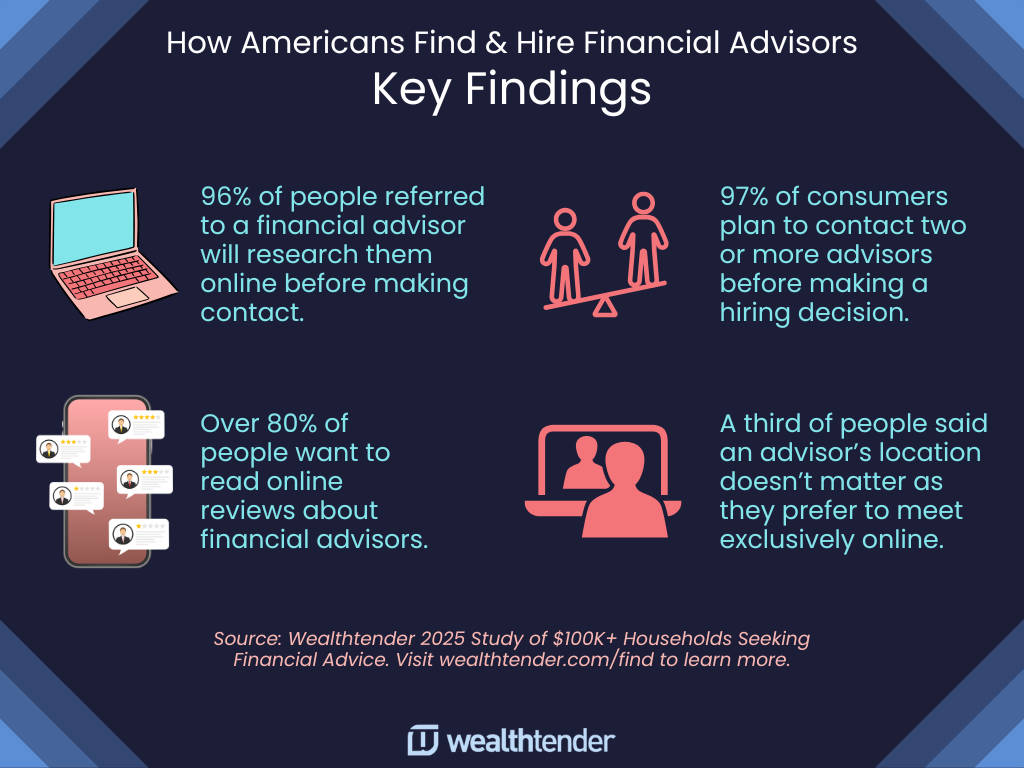
People do this because they like to know other people trust you. They’re looking for signs that you’re active in your industry and engaged with your community. They take note of podcast appearances, quotes in publications, speaking engagements, educational events, and any collaborations you might have with other professionals. They also pay attention to comments on your posts and how people interact with your content.
These are all important touchpoints contributing to your credibility.
What Should You Be Doing Differently?
With the understanding of how consumer behavior has changed, it’s time to take your social media strategy seriously.
Your individual and firm’s presence on social media has the power to push a prospect further down the sales funnel. It also has the potential to drive them away.
Do you know how effective your social media strategy is? Here are a few questions to ask yourself:
Am I only sharing educational or promotional content?
People come to social media to be entertained. Educational content is important, but make sure to mix it up from time to time. Share real stories, personal tangents, your take on current events, etc. Your humanity is what makes you compelling.
Am I interacting with others enough?
If you’re only posting and never commenting, liking, or sharing, you’re not doing social media right.
Do my visuals feel professional and aligned with my brand?
Any graphics, charts, downloadables, or photos you share should be in your brand colors, fonts, and style. Cohesion is important to your visual identity.
Am I sharing real photos of my team, office space, or community involvement?
Humans connect with humans. Show prospects the people behind the brand.
Do I regularly provide commentary on financial topics my ideal clients care about?
Keep your content relevant to your target audience. If you’re trying to attract pre-retirees, find opportunities to address their pain points and speak directly to them.
Do I come across as a real person or another generic financial services account?
If your profile name and photo were removed, could someone tell your post from another advisor’s? Your unique voice needs to come through if you want to be memorable.
Am I posting consistently?
Just like exercise, small but consistent efforts pay off over time. Only posting when you have time isn’t an effective strategy.
Your Digital Presence Is Part of the Client Experience
Consumers’ research habits and expectations have changed, and that includes how your target audience behaves online. Just as they’re perusing Instagram for the next new restaurant to try, they’re finding (or researching) your firm through social platforms as well.
Those advisory firms that recognize this shift have the upper hand. Now it’s more important than ever to optimize your social media presence to better build familiarity and establish trust early on.
Need help making yourself stand out on social media? That’s what we’re here for.
Sources: