
What is Social Media Optimization (SMO)?
Remember when marketing was all about SEO? Ah, the good ol’ days. But times have changed, and now we’ve also got SMO, or Social Media Optimization. (And AEO, too. We’ll get there.)
Here’s what we’re covering:
- What SMO is and why it matters
- Five steps to optimize your profile, content, and platforms
- Why organic comes before paid
- How SMO, SEO, and AEO work together
What is SMO?
This little acronym has become an important part of digital marketing strategy for anyone who wants to boost their online presence. SMO is the practice of using specific techniques on platforms like Facebook, Instagram, and LinkedIn so your brand:
- Shows up in the right places
- Reaches your target audience
- Drives engagement and builds relationships
- Generates more leads
Why it matters now: social media is often where people discover products and services before they discover anything else. A whopping 82% of consumers use social media platforms to discover and research new products in 2026. For a lot of your prospects, your social presence is the first impression.
How to Optimize
Of course, you want people to know your brand exists, but that’s not the only goal. You want people to take the next step, either right there in the post or by heading to your website. Here’s how to make that happen.
Step 1: Start With Your Profile
Think of it as your brand’s “About” page, except in this instance, people only give it about three seconds before deciding if they want to keep reading. If your profile doesn’t convince someone fast, they never make it to your content, let alone your website.
Your profile checklist:
- Bio: Clear, relevant, and includes the right keywords.
- Profile photo: Professional and recent. (Let’s try to avoid pictures from a different decade.)
- Branding: Consistent fonts, colors, and style, so your page looks like it belongs to one brand and not three.
- Website link: Easy to find. People don’t have the time to go on a deep dive for it.
Step 2: Format for the Scroll
Let’s keep this one simple. Did you know that the size of your Instagram post matters? Well. It does.
For Instagram and Facebook, use vertical images and graphics at 1080×1440 pixels (a 3:4 ratio). Why? Two reasons.
- Maximum quality. Most smartphone camera sensors are natively built in this 3:4 ratio, so capturing images at this size uses the entire camera sensor and retains the maximum resolution and pixel detail.
- Maximum screen space. Vertical posts take up more space when someone scrolls. That means your post is more likely to be the only thing on their screen at that moment, instead of having to compete. (Because let’s be real… it doesn’t take much for someone to get distracted.)
And most people are on their phones anyway, with 66.55% of worldwide web traffic coming from mobile devices as of August 2026, compared to just 32.08% from desktops. Format for the screen your audience is actually using.
PS: On LinkedIn, you can post vertical or horizontal, but vertical still tends to perform best on mobile.
Step 3: Create Content Worth Sharing
There’s already plenty of content floating around out there, so make yours count instead of adding to the pile. Comments, shares, and likes fuel the algorithm. The more engagement a post gets, the more the algorithm shows it to people who don’t already follow you. That’s extra visibility you didn’t have to pay for.
A few ways to earn it:
- Make it shareable. Think of something people want to send to a friend, whether that’s because it’s funny or because it’s useful.
- Make it eye-catching. Your images, videos, and posts should give people a reason to stop scrolling.
- Use the right keywords. In your bio and captions, so both platforms and search engines know what you’re about.
- Post when your audience is awake. Preferably during the day, not the 2 am doomscroll.
Want to go deeper on the type of content that connects with your audience? Check out this blog.
Step 4: Don’t Post and Ghost 👻
None of this works if you post and disappear. Social media is a conversation, so be part of it:
- Reply to comments and DMs.
- Talk to your audience directly on camera.
- Show up in other people’s posts, too, not just your own.
Think of it as a way to network digitally!
Step 5: Pick One or Two Platforms (and Commit)
You don’t need to be everywhere. Spreading out across five platforms usually means none of them get strong enough to convert. You already have so much to do, you don’t need to be stretched thin across your social media, as well. A couple of social platforms done well beats five done half-heartedly.
Choose the one or two platforms where your ideal clients actually spend their time.
Commit to showing up there consistently.
Check your analytics to see what’s working well and what needs some tweaking.
Build Organic Before You Pay for Reach
If you do all of this well, you can build reach without paying for it, which is the foundation you need before you spend a dollar on ads.
Ads amplify what’s already working. They don’t fix what’s broken. If your content isn’t doing well on its own, if your page isn’t converting, if your message isn’t clear, paid traffic just pushes more people toward something that’s not working. You’re paying to speed up a problem, not get a better result.
Before you run ads, make sure you have:
- Content people actually want to share instead of scrolling past
- A page that turns visitors into leads
- A message that’s clear on what you do and who you serve
- Once that’s in place, ads can really help. You’re not hoping that something works; you know that it already does. You’re just paying for it to reach more people.
Once that’s in place, ads can really help. You’re not hoping that something works; you know that it already does. You’re just paying for it to reach more people.
How SMO and SEO Work Together
SMO doesn’t work alone. It works hand in hand with SEO, or Search Engine Optimization, the process that boosts your website’s visibility in search engines like Google or Bing. The goal with SEO is to appear higher up on search engine results pages.
Think about the last time you searched for something online. Did you ever leave that first results page? Probably not. Almost 97% of clicks happen in the top 10 search results. So when you’re able to land on that coveted Page One, it gives your business credibility and authority.
Backlinks: The Trust Signal
A backlink is basically another website vouching for yours. When a trusted site links to your content, it tells both readers and search engines that your content is worth their time, so search engines treat those backlinks as a trust signal. Quality content tends to earn more backlinks, more quality backlinks tend to improve your ranking, and a higher ranking helps more people find you.
Why SEO Is a Long Game
Search engines update their algorithms A LOT, and it takes time for the quality and relevance of new content to be assessed, so it can be frustrating. But the good thing is that SEO builds on itself. Paid ads stop as soon as you quit paying for them, while SEO builds a foundation for ongoing traffic over time. It’s not going to happen overnight, but it’s well worth the effort.
Where SMO Comes In
Every step above feeds your SEO, too. Content that gets shared on social drives people to your website and gives other sites more reasons to link to you. More visibility tends to mean more traffic, and more traffic tends to mean more opportunities. Win-win!
What AEO Means for Advisors
And that organic foundation matters more than ever, because search itself is changing. AI is changing how people search, which means a strategy that once worked probably doesn’t anymore. More people are asking ChatGPT, Google’s AI Overviews, or another tool for answers instead of scrolling through a results page, and that’s where AEO, or Answer Engine Optimization, comes into play.
AEO is about shaping your content so AI tools will pull it into their answers. Instead of hoping for a click on Page One, you’re aiming to be the source the AI mentions when someone asks a question.
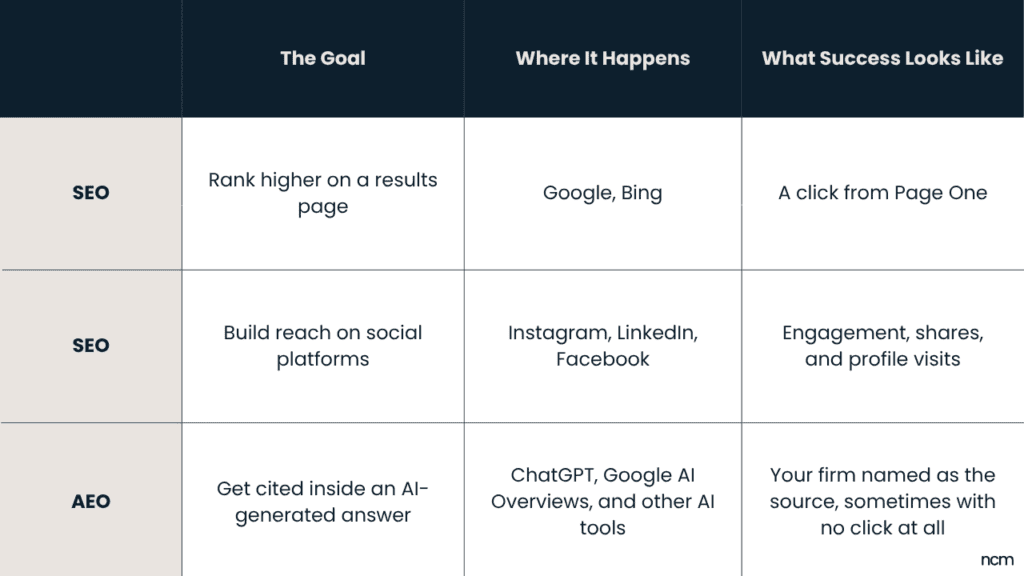
Each outcome is different, but the same work gets you there: clear, well-organized, credible content.
Want some good news? AI tools still favor content that answers a specific question well and comes from a source people trust. So the backlinks and organic work you’re already doing for SEO also help you show up in AI answers. This blog breaks down how to create content that helps you get picked up by tools like these.
This isn’t something you can skip. If your firm isn’t showing up when people ask AI tools for advice, you’re missing a growing part of how people research before they ever pick up the phone.
Final Thoughts
We know that marketing gets frustrating. But don’t take that the wrong way, because we do love it! We’re also realists, and some days you can do everything right and still not see results.
Part of that comes down to things outside your control, like the algorithm. (Womp, womp.) Stay consistent anyway. Success with SMO, SEO, and AEO builds over time, not overnight.
If you feel overwhelmed, that’s normal. Very few people start as experts. Look at what others in your industry are posting, see what’s getting the right kind of attention, and use it for inspiration.
And if you feel like you need a little help, don’t hesitate to reach out! You can comment here, send us a DM on Instagram, LinkedIn, email Niki, or schedule a strategy session.